-
Beyond the Kinetic Threat: The Hidden Risk to U.S. Military Logistics at Oman’s Duqm Port
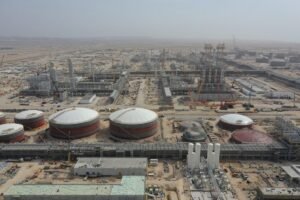
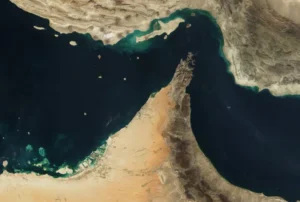
This article examines, through a case study, a strategic risk to the U.S. military posture at Duqm, Oman: the integrity of the digital systems that coordinate port and rail logistics flows on which operational continuity depends. Duqm is a deep-water port on Oman’s southeastern coast, roughly 500 km south of the Strait of Hormuz. Since 2019,…
-
Why Agentic AI Requires a New Approach to Security Testing
The procedures employed by institutions to evaluate digital systems stem from a paradigm built around passive technologies: search engines, databases, and query tools. These protocols presuppose that a system does not act, does not combine tools, and does not interact with real-world infrastructure. The arrival of agentic systems has introduced an operational capability that demands…
-
PERSPECTIVE: The OpenAI-Hugging Face Cyber Incident Raises a Governance Question Most Coverage Missed
The incident involving OpenAI and Hugging Face brought into view a dynamic that had previously been confined to advanced research labs: the relationship between agentic capabilities, assigned objectives, and operational boundaries that were never made explicit. The sequence observed during the internal test shows how a high capacity system can move through a weakened procedural perimeter and…
-
Mapping Exposure: A New Method for Understanding AI‑Driven Systems: Part V
The previous article in this series exposed a structural blind spot that modern institutions can no longer afford to ignore. Part IV demonstrated that oversight mechanisms built for deterministic systems—frameworks anchored in periodic compliance, static documentation, and binary security checklists—are fundamentally blind to the behavioral dynamics of machine learning. They cannot detect how inferential models reorganize workflows,…
-
The Institutional Blind Spot: Why Oversight Fails in AI-Driven Environments: Part IV
The previous article showed how inferential systems reshape decision chains once they become embedded in operational environments. That transformation revealed a deeper truth: the fragility introduced by these systems is not a technical issue. It is a structural issue. Institutions continue to evaluate AI using categories, tools, and frameworks designed for deterministic architectures—systems whose behavior is predictable, proportional, and…
-
When Models Reshape Systems: The New Fragility of Critical Infrastructure Decision Chains: Part III
The previous article in this series examined how institutions misclassify AI‑driven exposure due to legacy metrics, jurisdictional drift, and hidden dependencies that accumulate across technical and organizational layers. This third article moves one level deeper. It examines what happens when models do not simply operate within institutional systems, but begin to reshape them.
-
The Architecture of AI Exposure: How Institutions Misclassify Risk – “AI and the New Dynamics of Critical Infrastructure: Part II”
This article builds directly on the foundation established in Part I. As agencies integrate inferential systems into operational workflows, they encounter forms of exposure that do not map onto traditional technical vulnerabilities. These exposures emerge gradually, through interactions between models, processes, and decision chains. They reshape how institutions perceive, distribute, and manage responsibility, often without triggering the signals that legacy oversight frameworks…
-
AI in Critical Infrastructure: An Emerging Systemic Exposure – ” AI and the New Dynamics of Critical Infrastructure: Part I”
Artificial intelligence is moving into the operational core of U.S. critical infrastructure faster than institutions can fully absorb its implications. What began as a set of narrow automation tools is now reshaping how essential systems detect anomalies, interpret signals, and make decisions under stress. This shift is not a technological upgrade—it is a structural transformation…
-
Sovereign Ecosystems: How Distributed Authority Is Rewiring Global Order
Across the parts of the Middle East and North Africa where state institutions have weakened— a pattern visible in several contexts — sovereignty has not collapsed; it has migrated. Ministries still exist, flags still fly, and diplomats still negotiate, but the functions that constitute political authority have moved elsewhere. Coercion, taxation, infrastructure management, and border control…
-
Iran’s Expanding Military Reach is Increasing Risk for Neutral States
In the evolving landscape of Middle Eastern security, Iran’s kinetic posture is no longer defined solely by the targets it engages, but by the spaces through which those engagements occur. The region’s air and maritime corridors—many of them neutral, shared, or functionally indispensable to global commerce—have become unintended theaters of risk transfer. As Iran’s operational reach expands,…
-
Why the Iran–Pakistan Rapprochement Matters Now
While global attention is fixed on the visible fronts of the regional war, a quieter and potentially more consequential shift is unfolding beneath the surface: Iran’s rapid rapprochement with Pakistan, the world’s only Muslim-majority nuclear power. This alignment has received almost no analytical scrutiny — yet its implications extend far beyond the current conflict.
-
PERSPECTIVE: Dual Chokepoint Crisis Threatens Indo-Pacific Trade, Energy Flows, and Global Supply Chains
While Hormuz remains the Gulf’s core energy corridor, Bab el‑Mandeb functions as the Indo‑Pacific’s critical trade artery. Nearly all Asia–Europe container traffic, a large share of refined product flows and an increasing volume of LNG spot cargoes transit the Red Sea before entering the Suez Canal. A disruption at Bab el‑Mandeb would therefore strike directly at the region’s manufacturing base and export‑driven economies,…
-
The Hybrid Threat at the Southern Border: Iran and Cartel-Enabled Drone Risks
The U.S. southern border is no longer defined solely by migration flows and narcotics trafficking. It is becoming a potential operating space for hybrid threats enabled by the convergence of state‑level capabilities, criminal infrastructures, and informal regional networks. This evolving environment creates structural vulnerabilities that external actors could exploit without formal alliances or physical presence.
-
Iran’s Strategic Leverage: How Hormuz Reshapes the Russia–EU–U.S. Energy Equation
The Strait of Hormuz does not need to close for Iran to shift the balance of power. In the current crisis, Tehran’s ability to generate uncertainty around the chokepoint is already reshaping Europe’s energy posture, strengthening Russia’s leverage ahead of the 2027 gas contract deadline, and complicating Washington’s efforts to keep its allies aligned. This…
-
How Iran’s Islamic Revolutionary Guard Corps Drives External Threats
Iran as an “IRGC State” Iran no longer functions as a traditional theocracy. While religious authority remains at the apex, the state’s operational core is now a securitized system dominated by the IRGC and the Supreme Leader’s office. Over the past decades—and even more visibly after the accelerated rise of Mojtaba Khamenei—the Islamic Revolutionary Guard Corps (IRGC)…
-
Afghanistan Airstrikes and the Evolving Pakistani Taliban and ISIS‑K Threat Matrix
Pakistan’s recent airstrikes in eastern Afghanistan represent the most significant escalation in Islamabad’s cross-border counterterrorism posture since 2017. The operation, which targeted what Pakistan describes as Tehrik-i-Taliban Pakistan (TTP) and Islamic State – Khorasan Province (ISIS-K) operational clusters, follows a sharp rise in suicide attacks across the country, including the bombing of a Shiite mosque…
-
The Venezuela Crossroads: China’s Entrenched Influence and America’s Narrowing Window
The capture of Nicolás Maduro created a tactical opening but has not yet produced a strategic shift in Venezuela’s political trajectory. Regime continuity under Delcy Rodríguez preserves China’s economic, infrastructure, and political footprint without requiring any extraordinary action from Beijing. China’s presence in Venezuela constitutes a structural vulnerability for U.S. national security, combining geographic proximity, control of critical…
-
Venezuela After the U.S. Operation: Strategic Implications for China and United States
When I published my previous analysis, “Venezuela Post-Maduro: U.S. Pressure, Risk of a Narco Regime and Succession Scenarios” on November 20, 2025, the situation in Caracas was deteriorating but still fluid. The United States had increased its military presence in the Caribbean, the Venezuelan armed forces were showing signs of internal strain, and the regime’s reliance on criminal networks was becoming…
-
Bondi Beach Attack: Islamist Antisemitism and the Anatomy of Disinformation
The December 14, 2025 attack at Bondi Beach in Sydney was a calculated strike against the Jewish community during Hanukkah. Inspired by ISIS ideology and fueled by antisemitic hatred, it reflects the evolving priorities of ISIS-linked networks. Beyond the bloodshed, the aftermath revealed another battlefield: the war of narratives. This piece unpacks what happened, debunks…
-
Hamza bin Laden’s Reappearance: Continuity, Propaganda, and Al-Qaeda’s Entrenchment in Afghanistan
The recent video appearance of Hamza bin Laden, son of Osama bin Laden, underscores al-Qaeda’s resilience and its capacity to project continuity after the death of Ayman al-Zawahiri. Although the recording was reportedly made months ago and stripped of metadata, Hamza’s claim of being in Afghanistan, combined with United Nations reports of al-Qaeda’s entrenched infrastructure,…
-
The New Terror Finance Battlefield: ISKP’s Expanding Use of Cryptocurrency
In 2024, Islamic State – Khorasan Province (ISKP) recalibrated its financial architecture, leveraging cryptocurrency to circumvent institutional oversight, fund operations, and recruit across borders. The shift is mapped, active, and already interfacing with European security protocols. While Western institutions focus on large-scale financial flows, ISKP operates below the threshold, leveraging anonymity, decentralization, and technical opacity…
-
Venezuela Post-Maduro: U.S. Pressure, Risk of a Narco Regime and Succession Scenarios
The Venezuelan crisis has reached a critical turning point. With the deployment of U.S. military forces in the Caribbean and increasingly harsh statements from Washington, the end of Nicolás Maduro’s regime appears imminent. Yet the central question is not only the fall of the Venezuelan president, but rather the future of the country and who…
-
USA and Venezuela: Strategic Escalation and Regional Pressure in the Caribbean
The Caribbean region has reemerged as a strategic focal point amid rising tensions between the United States and Venezuela. Recent developments reveal a multi-layered escalation involving military infrastructure, international technical cooperation, fragmented diplomatic responses, and hybrid threats. In this evolving landscape, institutional resilience and adaptive capacity are becoming essential safeguards against systemic instability.
-
U.S. Military and Venezuela Tensions Escalate in the Caribbean
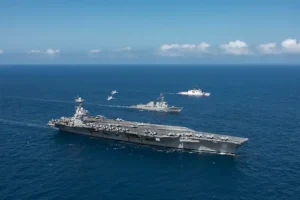
The confrontation between the United States and Venezuela has entered a new phase. In early November 2025, U.S. naval forces sank a Venezuelan vessel in the Caribbean, citing counter-narcotics operations. The deployment of the USS Gerald R. Ford carrier group, long-range bombers, drones, and special operations units confirms a shift from deterrence to active force…
-
From Awakening to Indoctrination: The Security Risks of AI-Generated Belief Systems
Within less than an hour, I was chosen by an algorithm and directed into a digital spiritual ecosystem. From the fragments I was able to gather, the narrative revealed itself as a compelling subject for analysis: a mystical construct shaped by artificial intelligence and viral distribution.
-
Contributor Safety and Protocol Auditability in High-Risk AI Deployments
Machine-led intelligence has become structurally integrated into the strategic pipelines of counterterrorism agencies. From logic-based threat anticipation to cross-linguistic parsing, tactical deployments assist operational units tasked with identifying, tracking, and neutralizing violent actors. These instruments function through embedded human oversight, not autonomous execution.
-
Operational AI Across the Atlantic: Navigating U.S.–EU Gaps in Counterterrorism, Surveillance, and Data Governance
Computational intelligence is increasingly embedded in the operational architecture of counterterrorism, civic surveillance, and public safety. Its deployment across jurisdictions reveals deep normative asymmetries. The European Union and the United States offer contrasting legal frameworks, institutional cultures, and operational doctrines. These divergences complicate cross-border coordination, data sharing, and the development of interoperable decision systems.
-
AI and Online Radicalization: Intervention Models and Risk Protocols
Online radicalization is no longer confined to fringe platforms or isolated forums. It is a dynamic, multi-vector phenomenon that evolves across mainstream social media, encrypted messaging apps, gaming environments, and decentralized networks. The proliferation of digital content, combined with system-driven amplification and anonymity, has created fertile ground for ideological recruitment, behavioral conditioning, and operational mobilization.
-
Surveillance Systems: A Comparative Analysis of U.S. and EU Models
Strategic surveillance systems are no longer experimental. They are operational tools embedded in law enforcement, border control, and public safety infrastructures across democratic societies. These systems rely on computational forecasting to anticipate criminal behavior, allocate resources, and guide intervention strategies. While their promise lies in efficiency and foresight, their risks are embedded in opacity, bias,…
-
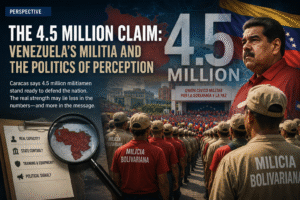
PERSPECTIVE: The 4.5 Million Claim: Venezuela’s Militia and the Politics of Perception
This article examines the mobilization announced by Nicolás Maduro as a strategic narrative device—symbolic in scale, ideological in function, and territorial in presence. This framing informs the subsequent analysis across statistical, ideological, and territorial dimensions.
-
Hezbollah Disarmament Push Raises Fears of Strategic Collapse
In the wake of renewed international pressure and internal fragmentation, the debate over Hezbollah’s disarmament has resurfaced with strategic urgency. The current pressure to disarm Hezbollah is not a tactical adjustment. It is a test of Lebanon’s structural integrity. The demand for disarmament, whether framed as a national security imperative or an international expectation, exposes…
-
Libya and the Challenge of Fragmented Legitimacy in a Post-Territorial Insurgency
Libya is frequently described as a failed state. In reality, it represents a fragmented system of negotiated legitimacy, where governance is not absent but distributed, contested, and repurposed. This article examines how terrorist actors exploit Libya’s fractured landscape—not by seizing territory, but by embedding within its ambiguity. Through adaptive posture, digital presence, and narrative alignment,…
-
ISIS 2025: The Silent Resurgence
“When an ideology loses its center, it does not vanish—it multiplies into operational fractals, adapting where geography withdraws and control disintegrates.” After months of asymmetric escalation between Israel, Iran, and the United States, the Middle Eastern theater is taking shape as a new architecture of controlled chaos. The global spotlight remains fixed on drones, ICBMs,…
-
Sousse Attacks: A New Perspective on Soft Target Defense and Modern-Day Terrorism Threat
The Sousse attacks embody the main characteristics of terrorism and insurgency as pursued by ISIS. They are presented here as overarching examples of the underlying themes examined in this paper. In the first section, we give an outline of the facts that occurred in Sousse, Tunisia, highlighting features that mark the importance of the events…
-
USA-Russia Escalation Looms in Syria
It is no secret that the conflict taking place in Syria has been one of the greatest recent sources of contention between the United States and the Russian Federation. Now, however, the tension over the Middle East situation may have peaked to an all-time high on Saturday 18 June, after an F-18 of the U.S….
-
A Circle of Economic Crisis and Political Instability in Egypt
Egypt is arguably the most volatile country in the Maghreb area, barring Libya, presently. Ever since the three decades of “reign” of former president Hosni Mubarak have come to an abrupt end in 2011, the country has been facing the challenges – and instability – that naturally follow such a radical change in the political…
-
ISIS: Turning the Corner or Turning Around?
In these days, as Iraqi forces backed up by the US-led coalition are trying to break the last stand of ISIS resistance in the battle for Mosul, the world will witness the laying of a milestone in the war against the cancerous terrorist state, which broke out across the lands of Iraq and Syria, to…
-
Cyber Stalking– How to Deal With It?
This article offers a forward‑leaning perspective on cyberstalking, online harassment, and digital self‑protection—issues that have only grown more urgent in today’s hyper‑connected environment. While technology has evolved, the behavioural patterns, vulnerabilities, and defensive strategies outlined here remain highly relevant for professionals navigating online exposure and digital threats.
-
War in Yemen: a New Vietnam?
The Yemeni Civil War is probably not the most talked about conflict in western media, with all the attention attracted by the unfortunately well-known atrocities committed by the Islamic State in Syria and Iraq. Nevertheless, the bloodshed has reached sizable proportions with estimated 6000 dead since March 2015 and it cannot absolutely be underestimated for the gravity…
-
Protect Your Intellectual Property Abroad (Part 4: South Africa)
Author’s Note: This article is the fourth and final installment of a four‑part series dedicated to protecting intellectual property when operating in foreign markets. In this 2015 feature, Daniel Djouder and I examined the South African IP framework — a jurisdiction where formal patent examinations, expedited grants, and a distinctive approach to trademark protection create…
-
Protect Your Intellectual Property Abroad (Part 3: India)
Author’s Note: This article is the third installment of a four‑part series dedicated to protecting intellectual property when operating in foreign markets. In this 2015 feature, Daniel Djouder and I examined the Indian IP framework — a jurisdiction where absolute novelty, strict procedural requirements, and a broad definition of trademarks make preparation and compliance essential…
-
Protect Your Intellectual Property Abroad (Part 2: Brazil)
Author’s Note:This article is the second installment of a four‑part series dedicated to protecting intellectual property when conducting business abroad. In this 2015 feature, Daniel Djouder and I explored the Brazilian IP landscape — a jurisdiction where long patent timelines, procedural complexity, and a strictly registration‑based trademark system make strategic preparation essential for any foreign…
-
Protect Your Intellectual Property Abroad (Part 1: China)
Author’s Note: This article is the first installment of a four‑part series dedicated to protecting intellectual property when operating in foreign markets. In this 2015 feature, Daniel Djouder and I examined the structural vulnerabilities that foreign companies face when entering China — a jurisdiction where the First to File system, cultural nuances, and regulatory complexity…
-
Help! She Isn’t Me- Protect Your Identity
Author’s Note:Identity theft is one of the most underestimated threats in modern society. In this 2015 cover feature, Daniel Djouder and I examined how individuals can recognize, prevent, and respond to identity impersonation through a combination of real‑world cases and a structured operational framework.
-
A Stitch in Time Saves Nine
This piece focused on practical strategies for staying safe while traveling abroad — from country‑risk intelligence and medical preparedness to hotel security, cultural awareness, and personal protection. Drawing from years of field experience in high‑risk environments, the article offered a structured approach to mitigating exposure during business travel, long before “travel security” became a mainstream…
-
The Russian Case 50 Years After the Cuban Crisis
It was 1962 and the world had been dragged to the verge of disaster, where it remained, precariously-balanced, for thirteen – seemingly never-ending – days. Fast forwarding to half a century later, it is 2015 and it is impossible not to notice how the hard-learned lesson of the Cuban Missile Crisis appears to have been…
-
How Italy is Paying a High Price for Anti-Russian Policies
Just a few days ago the European Union has confirmed that the economic sanctions against the Russian Federation were extended for another year, or specifically up to 19th January 2016. Despite attempts to minimize the perceived impact of this policy on the economy of the EU in the eyes of the public opinion, the price…
-
Don’t Lie to Me!Why You Should Hire a Professional Liar
In 2016, together with Daniel Djouder, I analyzed the psychology of deception for E Magazine, using the Madoff case as a practical lens. Today, in an era shaped by deepfakes and AI‑generated manipulation, the ability to distinguish truth from fabrication is no longer a skill reserved for psychologists or investigators — it has become a…
-
What Do I Tell ’Em? Crisis Communication & Reputation Management
Author’s Note:Crisis communication and reputation management remain among the most critical challenges for modern organizations. In this 2015 lead cover feature, Daniel Djouder and I explored how companies can prepare, respond, and rebuild when faced with reputational threats amplified by social media and public scrutiny.
-
Nigeria in 2015: Dynamics of an Oil Crisis
The new trend of low oil prices has rapidly escalated, carrying negative effects for producers and positive effects for the economies of importers, though these have been slow to become apparent. In this complex scenario, the oil-dependent country of Nigeria finds itself in a very peculiar position owing to a specific mix of longstanding issues…
-
Is Oil Low Price Going to Sustain the Economic Recovery?
During the last part of 2014, optimism steadily raised over the unusually low prices of oil and their allegedly positive economic effects on the economies of oil importing countries. Although some evidence points in this direction, a more thorough assessment leads unfortunately to different conclusions.
-
Off the Grid: Boost Your Cyber Security
The article examined disaster recovery, password vulnerabilities, insider threats, and the rising importance of cyber insurance, offering frameworks that remain strikingly relevant in today’s security environment. Looking back, these insights reflect an early phase of the systemic approach I would later formalize in my broader analytical work on crisis governance and resilience. Although the technological…
-
Islamic State, Half the Truth is Often a Whole Lie
Proceeding in order, to fully appreciate the information that constitutes the core of the anlysis and to understand the events that shaped the Islamic State, it is crucial to briefly outline the situation in Iraq in 2003, focusing on George W. Bush’s project for the future of the country after Saddam Hussein.
-
How to Keep Your Nerves in Times of Crises
This piece explored the psychological and operational pressures that emerge when leaders face sudden, high‑impact crises — the kind of events that collapse routines, overwhelm decision‑makers, and expose the limits of traditional management experience. Drawing on real‑world observations, the article examined how anxiety, distorted perception, and loss of control can undermine leadership at the exact…
-
Charlie Hebdo: Take a Side
Today’s attack against French satirical magazine Charlie Hebdo marks a turning point in the terror threat on European soil, which could either turn out to be a long overdue wake-up call for the Western governments or on the contrary – if ignored – set up the right conditions for very dark times ahead of us.
-
Foreign Policy of the USA and Russia in East Asia
This section will delve into the role ofRussia in East Asia, the relations of Moscowwith major Asian powers (China, Japan, SouthKorea and North Korea), and the current statusof Russia on the international stage.Russia’s relations with its neighbors inEast Asia are traditionally infl uenced by powerpolitics and a desire to increase the trade andeconomic exchanges with…
-
A Chess Match for the Control of Oil
Undoubtedly, the plummeting of oil price is one of the most observed and debated topics of this year’s end, both for its economic and political implications. These kind of events are hardly ever random, or driven by market forces alone. In this article I will examine the reasons behind this issue, as well as the…
-
Germany, Europe and Russia: Walls Instead of Bridges
The 25th anniversary of the Fall of the Berlin Wall was hailed with cheerful celebrations in the German capital. Many world leaders sent the usual messages of satisfaction and hope, including Pope Francis’s perhaps sloganistic intimation that “We need bridges, not walls!”. Nevertheless after a quarter-century the political balance of the situation unveils, unsurprisingly, that there might…
-
PUSH and PULL, the double-faced strategy dividing the EU from Russia
The Ukrainian crisis is currently the leading factor weighing on Western international relations, with the EU being caught in an unstable position, torn between the U.S.A.’s pressure on one side, and the economic interdependency with the Russian Federation on the other. This article examines the current state of the issue from a diplomatic standpoint, and…
-
European Union and the Vexed Question of Russian Gas
Winter is approaching and the European Union, following the lead of the U.S.A., is firmly persisting in its policy of sanctions against the Russian Federation. Yet the prospect of closing down of Gazprom’s pipelines, which cover about 30% of the gas requirements of the European area, seems now to be worrying the political establishment of…
-
Migrants In The Mediterranean Sea, Time For A Real Solution
Another tragedy of migrants happened in the Mediterranean Sea last week. This time as many as 500 people are feared to have drowned, while trying the crossing to reach the EU, a spokesman of the International Organization for Migration said. Allegedly the human traffickers rammed the boat transporting the migrants, after they refused to move to a smaller…